No more incorrect invoices: how e-commerce is ending courier overcharges

What do house renovations and e-commerce deliveries have in common? You never know the final price until the invoices start arriving.
From fuel surcharges and customs clearance to irregular dimensions and tricky destinations, couriers add a whole range of charges after processing shipments, so the actual cost of sending a package rarely ends up the same as the label price. According to Sendcloud, the average surcharge per shipment is £0.96 (€1.10), which can make a huge difference if you're an e-commerce brand shipping 10,000 packages per month.
While these surcharges are outlined in courier contracts, the calculations are opaque and not always correct. E-commerce brands used to rely on manually identifying these billing errors, but now they've got a helping hand: AI courier auditing.
Courier overcharges: the main offenders
Packaging penalties. Residential delivery penalties. Overweight penalties.
Couriers add surcharges after processing, so you pay for a label, but your invoice says something completely different a few weeks or months later. Fashion, Home & Garden, and Food & Beverages are the e-commerce segments that most commonly face additional charges, which tend to arise from:
- Dimensions - Especially if the parcel's size and weight exceeds the courier's minimum/maximum limits or the parcel is non-conveyable (i.e. the shape cannot easily be processed on conveyor belts, like L-shaped boxes).
- Packaging - For instance, if the item is fragile or 'non-bendable', or the label cannot easily be read by their scanners.
- Destination - While distance is baked into the label cost, some couriers will charge costs for specific destinations, such as private addresses or difficult-to-reach areas, like islands.
- Customs clearance - Since Brexit, you now need detailed info on goods travelling to the EU or face extra processing costs.
- Seasonality - Some couriers will charge more to send items at peak times, be it weekends or Christmas.
- Fuel - As prices fluctuate, so do delivery costs with couriers typically changing their fuel fees on a weekly basis or after oil price shocks. For example, FedEx and UPS have hiked fuel charges since the Iran war.
- Exceptionality - This covers a broad range of sins - from unusual deliveries to additional processing.
To be clear: most surcharges are agreed costs, outlined in courier's contracts. They are rarely 'hidden' extras. But they are frequently wrong.
Courier surcharges: common billing errors
Invoice mistakes happen. Whether it's misplaced decimal points or duplicated line items, issues can arise at any stage of the shipping process that ultimately lead to a billing error. For example:
- Late express shipments - You pay for two-day delivery, the shipment arrives three days later, but you still get charged for Express.
- Overweighing packages - Whether it's human error or accidentally weighing the wrong box, couriers can mark down parcels as heavier than reality, potentially turning what would be a £4 shipping cost into a £40 cost.
- Billed not scanned - Not every label that's created ends up being sent. But when it comes to invoicing, you're still charged for that label.
With 5 billion+ e-commerce packages sent every year in the UK alone, couriers are stretched to capacity and the likelihood of surcharge errors is growing.
Given e-commerce brands ship thousands of items every week and invoices tend to arrive weeks or even months after delivery, it's hard to validate if surcharges are correct and keep track of discrepancies - with a member of the logistics team usually tasked with manually checking, identifying and filing claims for errors. Until now.
Catching incorrect invoices with AI auditing
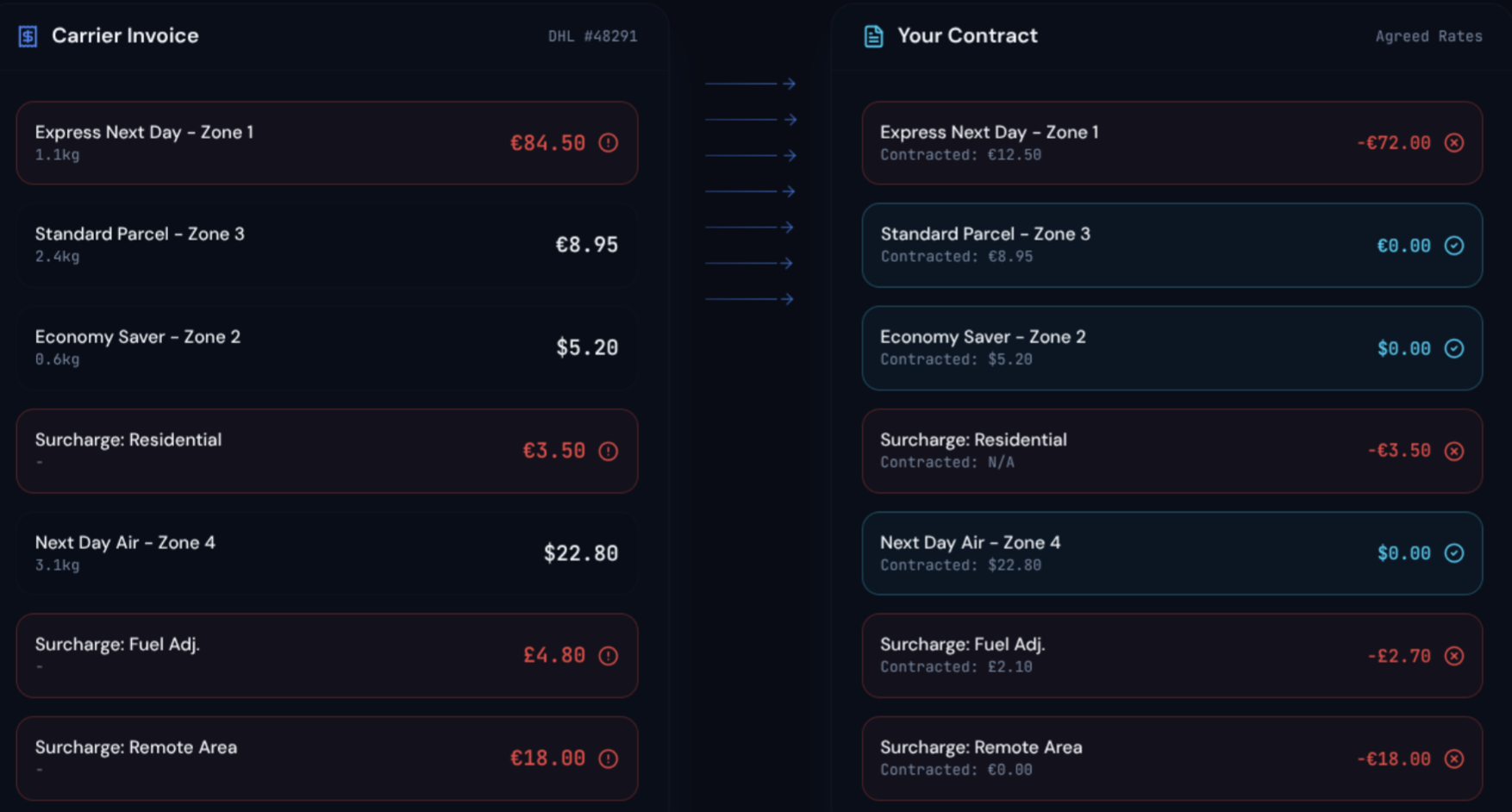
With AI invoice auditing, you can instantly audit every single courier invoice, comparing all the surcharges with your contracted courier rates, and identify duplications or misbilled shipments.
At Claimit, for example, our platform automatically cross-references every category of charge - from weight to zone tables - against actual shipment data and your contracted rates, flagging any billing errors and discrepancies (we have found that around 4% of shipping invoices are incorrect). As our invoicing tool is integrated with our claims tool, the platform then automatically files compensation claims with couriers and recoups money from misbilled invoices, so you always pay for the service you agreed to and not for the courier's mistakes.
To learn how Logistics Managers are using these tools, read our latest blog.
Related Articles
Line-by-line: How Logistics Managers are recouping misbilled shipping costs with AI invoice auditing

The logistics case for automating courier claims in consumer electronics